
Eric Marienthal: Surrounded by Greatness
Eric Marienthal: Surrounded by Greatness
The saxophonist reflects on his storied career and his relationship with the festival
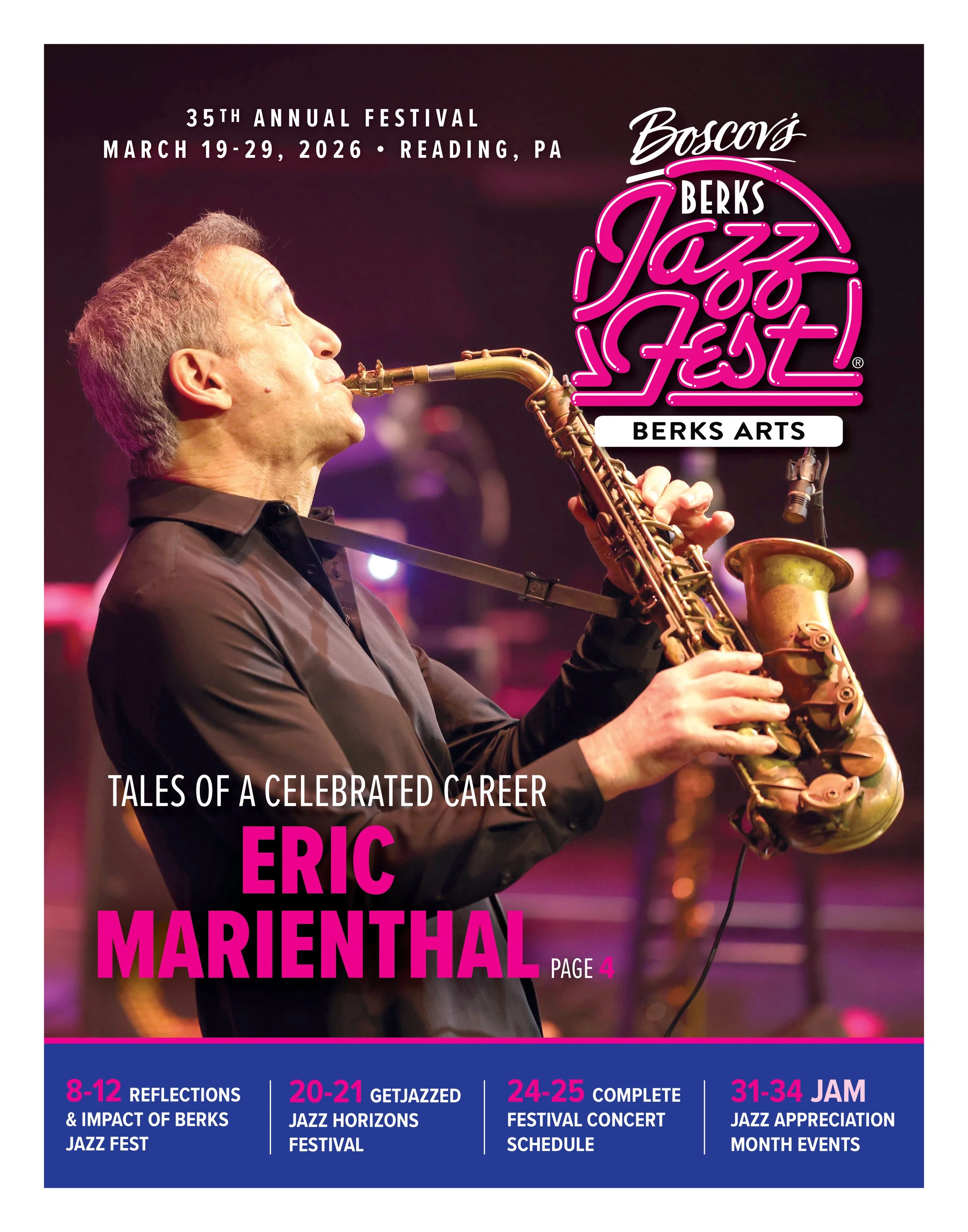
Eric Marienthal is no stranger to the Berks Jazz Fest and its audience.
The saxophonist has been appearing at the festival year after year for almost three decades. A veritable MVP, he’s truly become part of the festival’s family, loved and respected by both fans and musicians for his stellar musicianship, as well as for his magnanimous presence.
However, Eric Marienthal was by no means an overnight success. His journey as a creative artist started from humble beginnings and he evolved, based on both talent and fortune, not only to become an important collaborator with several of the greatest artists in contemporary jazz, but also to become a powerful and influential artist of his own.
Born and raised in Southern California, Marienthal was introduced to jazz at a very young age by his father, who loved jazz singers, including greats like Sarah Vaughan, Ella Fitzgerald, Frank Sinatra and others. So when, as a middle-schooler, he got into jazz and orchestra band in high school as a nascent saxophonist, the sound and the arrangements were all so familiar to him.
But as much as he loved playing in those school bands, Marienthal had no idea what he wanted to do with his life, other than playing music.
But how and where? He had a guitar player friend, Steve Recker, who had gone to Berklee School of Music and wrote Marienthal about the great time he was having. Come join me here in Boston, he told the young saxophonist.
The only problem was that Marienthal didn’t have any money. Instead, he went to a local community college where he studied music, but during that time he also worked as a busboy at various local restaurants, doing both lunch and dinner shifts to save as much bread ($), as well as actual bread, as he could. It turns out that income was enough back in the late 70s to pay for one year of tuition at Berklee. Encouraged by his teacher there at that community college, he applied and got into the prestigious music school.
The saxophone teacher Joe Viola was a formative influence, but for Marienthal, like many jazz music students, the greatest lessons learned there at Berklee were not necessarily in the classroom, but rather in the practice room and on the bandstand.
There was one class that particularly captivated the young saxophonist. The noted jazz arranger and educator Herb Pomeroy taught a class in which a student big band would play from some of his best charts, including those with the music of Duke Ellington.
“We met every Tuesday and Thursday,” Marienthal recalls. “And every Thursday we'd go into the studio for a two-hour recording session. That got me very excited about becoming a studio musician and that's absolutely what I was planning on doing. I just wanted to go back to L.A. and be a studio musician.”
Returning to L.A. after his formative experience at Berklee, Marienthal did not replace the likes of Ernie Watts or Tom Scott in the studio scene. He did work around town with various bands, until a friend of his working with the noted New Orleans trumpeter Al Hirt called to offer him a gig playing traditional jazz with the New Orleans legend there at his club on Bourbon Street, as well as on the road for various shows during the weekend. It was an offer he couldn’t (and didn’t) refuse.
In the 60s and 70s, Al Hirt was incredibly popular as both a recording artist and touring performer, with an outsized sound and presence. For Marienthal, the opportunity to play regularly with a working band and travel to cities all over the country was the beginning of a long career doing just that.
“It was a steady gig,” he says. “It was all part of the path and the learning.”
After a year with Hirt, Marienthal returned to L.A. where he worked as a member of the Disneyland band, a full-time, five-days-a-week, 52-weeks-a-year job with benefits.
At that time in the mid-80s, Chick Corea was looking for a saxophonist to add to his recently formed electric quartet. His bassist John Patitucci recommended Marienthal, and after Corea saw the saxophonist live at a local L.A. club, he had his manager call Marienthal to offer him the job.
After calling Marienthal’s home without connecting, the manager finally reached him in the band room at Disneyland and asked if he was available to tour with Corea’s new group, which came to be the Elektric Band. Marienthal promptly gave his notice to Disneyland.
“Very promptly,” he says, laughing.
Marienthal would go on to record six albums with Corea, as well as tour regularly with the keyboardist until his untimely death in 2021.
“Chick was such an improvisational genius,” Marienthal says. “I always say that I wish every musician I know could have had the experience of working with Chick Corea. He really taught us what it meant to play in a small ensemble. What it meant to communicate. What it meant to improvise. How to share ideas and expand on each other's input. How to lift the overall performance of the group.”
Marienthal says that during live shows, his solo often would have to follow Corea’s.
“Over the course of 35 years of traveling with him, it taught me that you always have to be thinking,” he explains. “You always have to be listening. You always have to be creating. It was always about being different. He certainly led by example. Every single solo he ever played was completely unique. You could tell it was Chick Corea, but you could also tell that he was always stretching, always searching. You wanted to try to be as creative as Chick, which was no small feat, but it was something to strive for every night.”
Throughout those years as a member of Corea’s band, Marienthal’s own career evolved with numerous recordings and collaborations. Since his debut recording Voices of the Heart in 1988, Marienthal would go to record more than a dozen albums as a leader, in addition to numerous recordings with the Rippingtons, Gordon Goodwin and many others.
One of his most interesting, albeit relatively unknown, credits is as one of the “ghost” saxophonists for Lisa Simpson, who of course was mentored by Bleeding Gums Murphy on the hit show, The Simpsons. He also played sax parts on Family Guy and Soul, amongst other shows or films for Disney and Pixar. He says that it’s just like doing any job as a session musician, his veritable day job.
“It’s incredibly different than fronting your own band in front of a live audience, which is very open and interactive and different each time,” Marienthal says. “The whole challenge of being a studio musician is precision, because 99% of that music is written. At the end of the day, you don't measure your performance by how well you did. You absolutely measure it by how few mistakes you made.”
Since 2018, Marienthal has also served as the music director for several of the jazz and music cruises produced by Signature Cruise Experiences (SCE), including The Jazz Cruise, The Smooth Jazz Cruise, Journey of Jazz, Botti at Sea and others.
Marienthal’s role with those programs is to schedule the dozens of concerts and events throughout each week which, given the number of venues and artists, comprise a remarkable puzzle.
“I get to work with literally hundreds of musicians,” he explains. “I get to put these programs together that make thousands of people who come to the cruises incredibly happy and take them out of the world in which they are living and let them experience a week of something very special. It has taught me a lot about organization, music management and arranging. Plus, I get to perform with some of the best musicians in the world. It’s just nothing that I could possibly imagine.”
Michael Lazaroff, the executive director of SCE, said: “Given his musical prowess, congenial personality, and dedication to excellence, Eric is the perfect person to create, curate and conceive the amazing music programs we present.”
During the Boscov’s Berks Jazz Fest, SCE will present a sampling of the cruise experience with a March 28 concert featuring Marcus Miller & Friends, which will feature the bassist (and host of The Smooth Jazz Cruise and Journey of Jazz) along with Marienthal, Warren Wolf and Ravi Coltrane.
Marienthal’s relationship with the Berks Jazz Fest dates to 1996 when he first appeared with his band. Over the years, he’s performed in various configurations at just about every venue in Reading, doing everything from headlining concerts to organizing special shows and jams. He’s come to appreciate both the diversity and the vibe of the festival.
“It’s unique in every way, including the span of musical taste that the festival offers, because there's straight ahead jazz, smooth jazz, contemporary jazz and fusion,” Marienthal explains. “Somehow John Ernesto has a way of making it all work. Also, at most jazz festivals, the artists are there just for one night, but Berks is different because they’re in town for multiple days and get to interact more with the audience.
“Similar to the jazz cruises, it’s become this family of artists, fans and also patrons. There are over 200 volunteers that work every year. That family aspect is an important part of the tradition of the festival.”
One recent tradition of the festival is the Chuck Loeb Memorial All-Star Jam, an annual event that was renamed in 2018 to honor the late guitarist’s legacy, but also to raise funds for a scholarship given to student jazz ensembles. Marienthal was very close to Loeb with whom he played in various bands and recordings over the years, most notably the 2015 Bridges album. He remembers both the man and the musician, who died of cancer in 2017.
“In my opinion, Chuck made it cool to be a smooth jazz artist because he really could do anything,” Marienthal says. “He could write and record these incredibly great smooth jazz tunes. And then turn around and play the most impressive straight-ahead jazz guitar you’ve ever heard. He could just do it all. And he was one of the smartest guys I know, as well as a kind and beautiful person.”
That ability to move deftly between jazz genres is something Marienthal himself shares not only with Loeb, but also with another longtime friend and colleague, Randy Brecker, with whom he recorded the Grammy-nominated album Double Dealin.’
“Eric has a big, beautiful sound with great time and musicality,” Brecker says. “And he can play any style that’s called for, including adjusting certain aspects of his playing just enough to fit into any and every setting one can imagine and yet still sound uniquely like Eric Marienthal.”
Last year, Marienthal presented a tribute to the late David Sanborn, yet another esteemed longtime friend and colleague. That concert featured Mindi Abair, Kirk Whalum, Eric Darius, Alex Han and Marienthal performing the influential saxophonist’s music.
This year in a concert with the Reading Pops Orchestra on Sunday, March 29, Marienthal will play the third movement from the “Concerto for Saxophone” composed in 1989 for Sanborn by the noted arranger Michael Kamen. The entire work was originally recorded by Sanborn and Kamen with the National Philharmonic Orchestra and released on Warner Bros. Records in 1990. However, the concerto remained unpublished until the Australian saxophonist Amy Dickson reached out to Kamen’s family to find the score and then perform it with the Melbourne Symphony Orchestra in 2013.
Marienthal himself has performed the entire concerto a few times and as a result has come away with even more regard for Sanborn’s unique gifts.
“I must have listened to David’s original recording a thousand times,” he says. “I practiced it for months and months, because it’s really challenging. I came to realize just what a master saxophone player he was. His approach to melody, his approach to intonation, his approach to phrasing, his approach to blending and listening to an orchestra … the way he would lead in the same way that any other soloist like Pavarotti or whoever would. It made me appreciate David that much more, that he could take his musicianship and translate it into that setting as well as he did.”
John Ernesto, longtime general manager of the Berks Jazz Fest, sums up Marienthal’s contributions to the festival, and to the Reading community, over the years.
“I have been fortunate and blessed to have had the opportunity to work with many wonderful artists over the years,” said Ernesto. “A select group have become true musical partners, collaborating with me to create unique concert presentations — many shows that fans can experience only at the Berks Jazz Fest.
“Eric has been one of those valued musical partners for many years, along with Chuck Loeb, Rick Braun and Gerald Veasley. Collaborating with Eric has been a joyful process.
“Whether developing a major concert presentation or working with young musicians through jazz education programs, Eric is fully committed to creating memorable musical experiences for fans of all ages.”